Family & children
How to fill out the Kindergeld application (KG 1)
Kindergeldantrag · KG 1
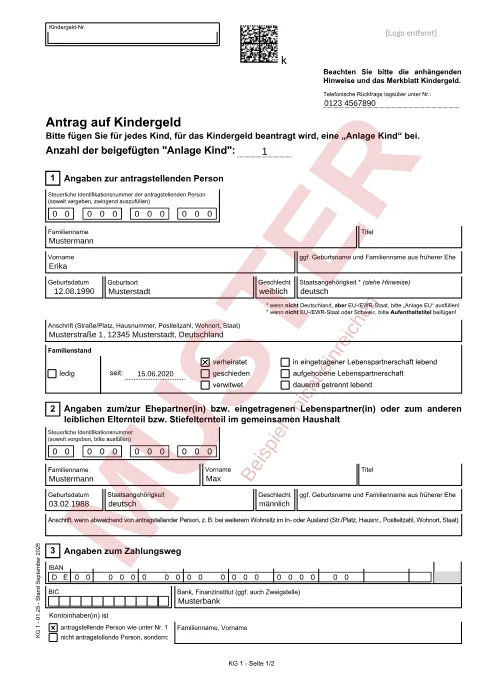
The KG 1 “Antrag auf Kindergeld” is the main form for child benefit (Kindergeld) from the Familienkasse, the family benefits office of the Federal Employment Agency. You use one KG 1 for all your children and add a separate “Anlage Kind” (child supplement) for each child.
Official form from the Familienkasse (Federal Employment Agency)German information checked on 25 September 2026
Explanation only – the form must be submitted in German. German authorities work in German, so you fill in and hand in the German form. This page explains what each field means so you can do that correctly. Names, numbers and addresses stay as in your documents.
This English page is still being reviewed. It follows the fact-checked German page; a second person who reads English has not checked the translation yet. If in doubt, the German page and the official sources count.
No legal or tax advice. This page explains the form in general and does not replace advice on your individual case. Whether you are entitled to a benefit, or which answer is right for you, please ask the responsible authority, an advice centre (for example a migration advice service) or a lawyer.
Free to start. The assistant explains every field in English; the form is filled in in German.
This page in:DeutschУкраїнська
At a glance
- Who needs it?
- Parents (including adoptive, foster, step and grandparents) who apply for Kindergeld for a child for the first time – for example after a birth, after moving to Germany, or when the other parent should receive it from now on. If both parents live together, the parent who should receive the Kindergeld, as both agree, is the applicant.
- Where to submit
- At the Familienkasse responsible for you.
- Deadline
- There is no fixed deadline, but Kindergeld is paid back only for the last six months before the month in which your application arrives (§ 70 (1) EStG, German Income Tax Act).
- Length
- 5 pages, 96 fields detected
- Online alternative
- The authority also offers an online application (German).
What you need
- One completed “Anlage Kind” for every child you apply for
- The tax IDs (Steuer-ID) of the applicant and of every child – required if one has been issued
- If you are a citizen of another EU/EEA country: the “Anlage EU” supplement
- If you are a citizen of a country outside the EU/EEA/Switzerland: your residence permit (Aufenthaltstitel)
- If there is a link to another country (e.g. a parent or child lives or works abroad, foreign benefits, NATO forces): the “Anlage Ausland” supplement
- If a court decided who receives the Kindergeld: the court decision
- For children born in Germany, the birth certificate or the birth certificate for Kindergeld (Geburtsbescheinigung für Kindergeld) only if the Familienkasse asks for it; for children born abroad, official documents such as the foreign birth certificate
Field guide: section by section
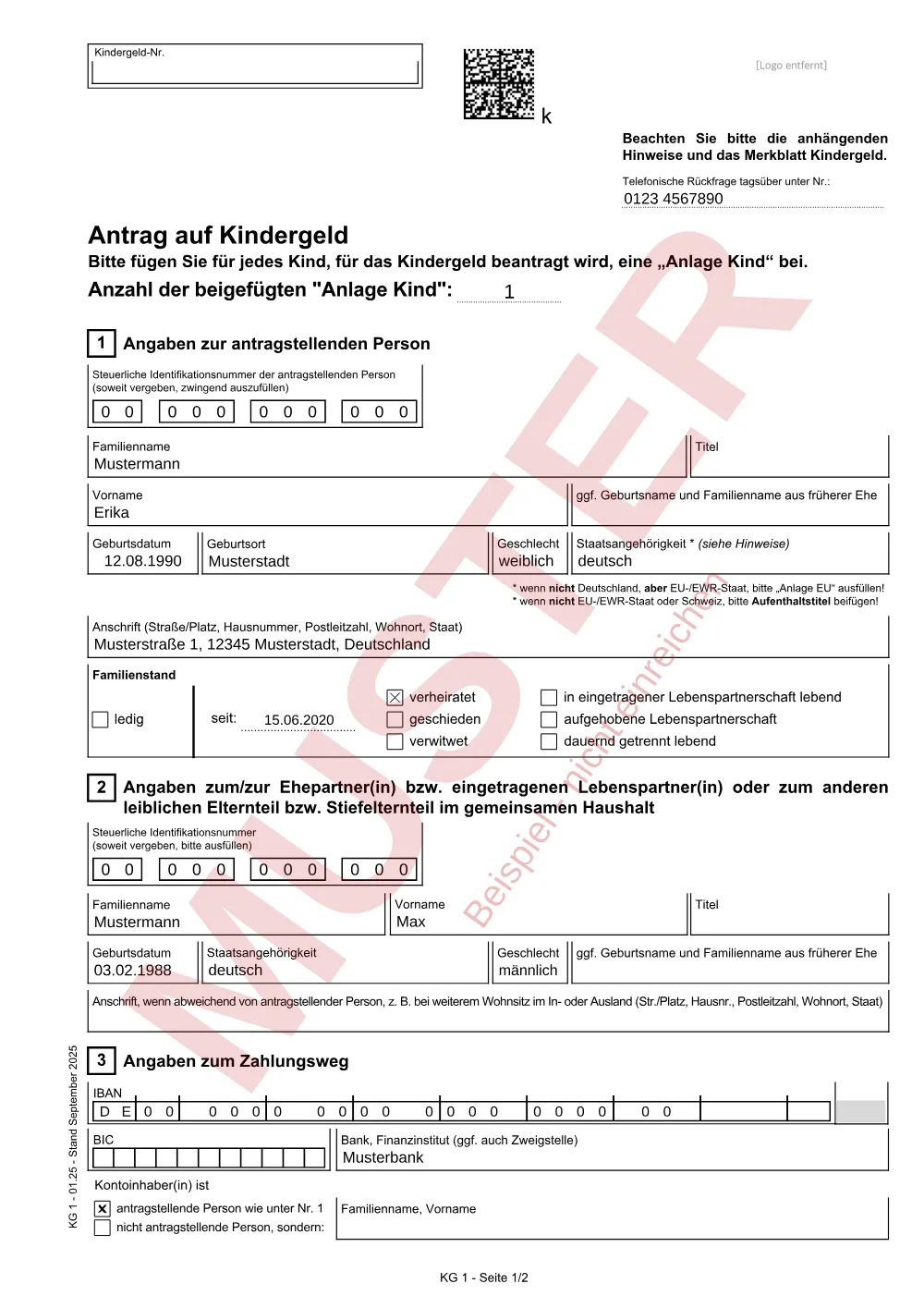
Header – Kindergeld number, phone and number of supplements
Kopf – Kindergeld-Nr., Telefon und Anzahl der Anlagen
Your Kindergeld number (if you already have one), a phone number where you can be reached during the day, and how many “Anlage Kind” you attach.
| On the form (German) | What it means |
|---|---|
| Kindergeld-Nr. | Your Kindergeld number from earlier letters of the Familienkasse. Leave it empty if this is your first application. |
| Telefonische Rückfrage tagsüber unter Nr. | A phone number where the Familienkasse can reach you during the day if they have questions. |
| Anzahl der beigefügten „Anlage Kind“ | How many “Anlage Kind” you attach – one for each child you apply for. |
Tips
- On your first application you do not have a Kindergeld number yet – leave the field empty.
- The number of supplements must match the number of children you apply for.
1 – About you (the applicant)
1 – Angaben zur antragstellenden Person
Your personal details, address and marital status.
| On the form (German) | What it means |
|---|---|
| Steuerliche Identifikationsnummer | Your tax ID (Steuer-ID), 11 digits. It is in the letter from the Federal Central Tax Office (Bundeszentralamt für Steuern), on your payroll tax certificate (Lohnsteuerbescheinigung) or on your income tax assessment. |
| Familienname | Your surname, as in your passport or ID card. |
| Titel | An academic title such as “Dr.”, if you have one. Otherwise leave it empty. |
| Vorname | Your first name(s). |
| ggf. Geburtsname und Familienname aus früherer Ehe | Your surname at birth and any surname from an earlier marriage – only if different from your current surname. |
| Geburtsdatum | Your date of birth, written the German way: DD.MM.YYYY. |
| Geburtsort | The town or city where you were born. |
| Geschlecht | Your sex as in your documents. |
| Staatsangehörigkeit | Your citizenship, e.g. “britisch”, “indisch” or “US-amerikanisch”. |
| Anschrift (Straße/Platz, Hausnummer, Postleitzahl, Wohnort, Staat) | Your address: street, house number, postcode, town and country (Staat). |
| Familienstand (verheiratet, eingetragene Lebenspartnerschaft, ledig, geschieden, aufgehobene Lebenspartnerschaft, verwitwet, dauernd getrennt lebend) mit „seit“-Datum | Your marital status: verheiratet = married, eingetragene Lebenspartnerschaft = registered civil partnership, ledig = single (never married), geschieden = divorced, aufgehobene Lebenspartnerschaft = dissolved civil partnership, verwitwet = widowed, dauernd getrennt lebend = permanently separated. Add the date since when (“seit”). |
Tips
- You find your tax ID in the letter from the Federal Central Tax Office, on your payroll tax certificate or in your income tax assessment.
- Tick “dauernd getrennt lebend” (permanently separated) only if at least one spouse wants the separation to be permanent.
- Citizens of another EU/EEA country attach the “Anlage EU”; citizens of other countries attach their residence permit.
2 – Spouse, registered partner or other parent in your household
2 – Ehepartner(in), eingetragene(r) Lebenspartner(in) oder anderer Elternteil im Haushalt
Details of the person who lives with you and who may have a parent-type relationship to the child.
| On the form (German) | What it means |
|---|---|
| Steuerliche Identifikationsnummer | This person's tax ID (Steuer-ID), 11 digits. |
| Familienname | Their surname. |
| Vorname | Their first name(s). |
| Titel | An academic title, if any. |
| Geburtsdatum | Their date of birth (DD.MM.YYYY). |
| Staatsangehörigkeit | Their citizenship. |
| Geschlecht | Their sex. |
| ggf. Geburtsname und Familienname aus früherer Ehe | Their surname at birth and from an earlier marriage, if different. |
| Anschrift, wenn abweichend (z. B. weiterer Wohnsitz im In- oder Ausland) | Their address only if it differs from yours, e.g. a second residence in Germany or abroad. |
Tips
- If the child's other parent does not live in your household, their details do not belong here but in the Anlage Kind (point 2).
- The person named here also signs at the end if they agree that you receive the Kindergeld.
3 – Bank account for the payment
3 – Angaben zum Zahlungsweg
The account the Kindergeld should be paid into.
| On the form (German) | What it means |
|---|---|
| IBAN | The IBAN of the account (in Germany it starts with DE and has 22 characters). |
| BIC | The bank's BIC (SWIFT code), shown in your online banking or on your bank card. |
| Bank, Finanzinstitut (ggf. Zweigstelle) | The name of the bank (and branch, if any). |
| Kontoinhaber(in) ist antragstellende Person / nicht antragstellende Person, sondern: Familienname, Vorname | Whose account it is: tick the first box if it is your own account; if not, write the account holder's surname and first name. |
Tips
- If the account is not yours, enter the account holder's surname and first name.
4 – Someone else should receive the decision letter
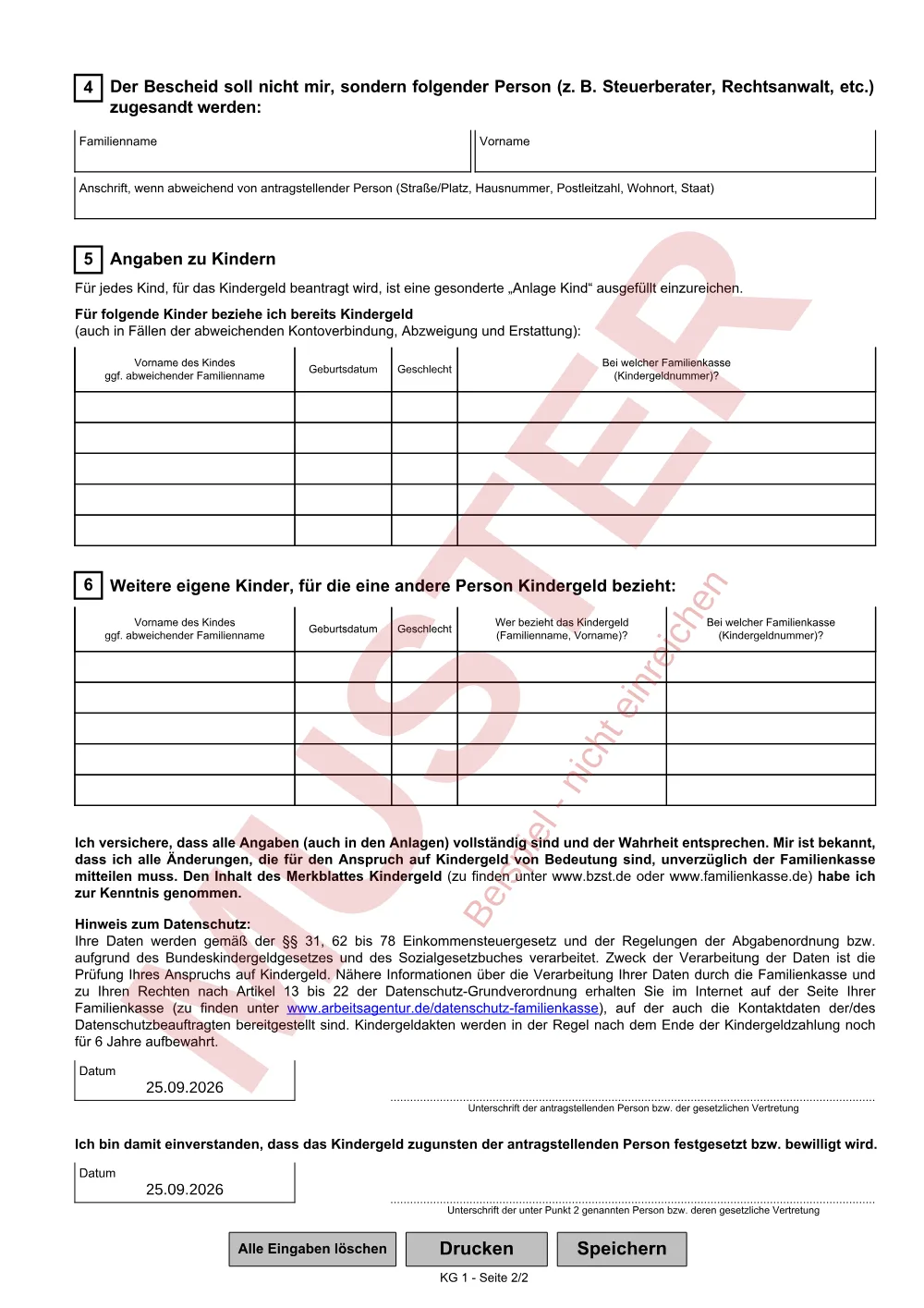
4 – Abweichende Empfangsperson für den Bescheid
Only fill this in if the decision letter (Bescheid) should go to another person, for example a tax adviser, a lawyer or a wage tax help association.
| On the form (German) | What it means |
|---|---|
| Familienname | That person's surname. |
| Vorname | That person's first name. |
| Anschrift, wenn abweichend von antragstellender Person | That person's address, if it differs from yours. |
Tips
- Leave this section empty if the decision letter should go to you.
5 – Children you already receive Kindergeld for
5 – Kinder, für die Sie bereits Kindergeld beziehen
Children for whom you already receive Kindergeld – also if it is paid to another account, diverted or reimbursed.
| On the form (German) | What it means |
|---|---|
| Vorname des Kindes | The child's first name. |
| ggf. abweichender Familienname | The child's surname, only if different from yours. |
| Geburtsdatum | The child's date of birth (DD.MM.YYYY). |
| Geschlecht | The child's sex. |
| Bei welcher Familienkasse (Kindergeldnummer) | Which Familienkasse pays it, and the Kindergeld number. |
Tips
- These children need no new Anlage Kind – they are only listed to establish the order of your children.
6 – Your other children for whom someone else receives Kindergeld
6 – Weitere eigene Kinder, für die eine andere Person Kindergeld bezieht
Your own children for whom, for example, the other parent or the grandparents receive the Kindergeld.
| On the form (German) | What it means |
|---|---|
| Vorname des Kindes | The child's first name. |
| ggf. abweichender Familienname | The child's surname, if different from yours. |
| Geburtsdatum | The child's date of birth. |
| Geschlecht | The child's sex. |
| Wer bezieht das Kindergeld (Familienname, Vorname) | Who receives the Kindergeld for this child (surname, first name). |
| Bei welcher Familienkasse (Kindergeldnummer) | Which Familienkasse pays it, and the Kindergeld number, if known. |
Declaration and signatures
Versicherung und Unterschriften
You confirm that your details are correct and that you have read the Kindergeld leaflet (Merkblatt Kindergeld). The person named under point 2 signs to show they agree.
| On the form (German) | What it means |
|---|---|
| Datum | The date you sign (DD.MM.YYYY). |
| Unterschrift der antragstellenden Person bzw. der gesetzlichen Vertretung | Your signature (or your legal representative's). |
| Datum | The date the person under point 2 signs. |
| Unterschrift der unter Punkt 2 genannten Person bzw. deren gesetzliche Vertretung | The signature of the person named under point 2 (or their legal representative). |
Tips
- If you are under 18, your legal representative signs.
- If you and the person under point 2 do not agree on who receives the Kindergeld, tell the Familienkasse.
5 pages, 96 fields detected · Alle Felder mit Beispielwerten (Deutsch)
Sample: a filled-in form
Common mistakes
- The tax ID of the applicant or of the child is missing – the form says it must be given if one has been issued, and it is a condition for the benefit.
- No “Anlage Kind” attached, or the number of supplements does not match the number of children you apply for.
- The person under point 2 forgot to sign, although they live in the same household and agree.
- Details of the child's other parent who does not live with you entered under point 2 instead of in the Anlage Kind.
- “Anlage EU”, “Anlage Ausland” or the residence permit missing although your citizenship or a link to another country requires it.
- Applying too late: the Familienkasse pays back only six months before the month your application arrives.
Where and when to submit
- Where to submit
- At the Familienkasse responsible for you.
- How
- Printed and signed, by post. Or online through the Familienkasse: with a BundID account fully electronic and without a signature; without BundID you print the online application, sign it and send it by post.
- Deadline
- There is no fixed deadline, but Kindergeld is paid back only for the last six months before the month in which your application arrives (§ 70 (1) EStG, German Income Tax Act).
Ausfüllpilot does not send anything to authorities. After filling in, you download the German PDF and submit it yourself.
Frequently asked questions
How far back is Kindergeld paid?
Kindergeld is paid back only for the last six months before the month in which the Familienkasse receives your application (§ 70 (1) EStG). Apply as soon as possible after the birth or after moving to Germany.
Source: Antrag auf Kindergeld KG 1 (PDF, Stand September 2025)
Do I have to send the birth certificate?
For a child born in Germany, you send the birth certificate for Kindergeld or the birth certificate only if the Familienkasse asks for it. For a child born abroad, you prove the relationship with official documents, such as the foreign birth certificate.
Source: Antrag auf Kindergeld KG 1 (PDF, Stand September 2025)
Can I apply without the paper form?
Yes. The Familienkasse offers an online application. With a BundID account you send it without printing or signing; without electronic identification you print the online application, sign it and send it by post.
Source: Bundesagentur für Arbeit – Kindergeld online beantragen · Antrag auf Kindergeld KG 1 (PDF, Stand September 2025)
Where do I find my tax ID and my child's?
In the letter from the Federal Central Tax Office (Bundeszentralamt für Steuern). Your own number is also on your payroll tax certificate or income tax assessment. Your child's number is sent to the child's registered address after the birth. You can request it again with the form on bzst.de – it is not given out by phone or email.
Source: Antrag auf Kindergeld KG 1 (PDF, Stand September 2025)
Which parent applies?
If both parents qualify, the applicant is the parent who should receive the Kindergeld, as both agree. The other parent in the same household also signs if they agree.
Source: Antrag auf Kindergeld KG 1 (PDF, Stand September 2025)
Can I fill in the form in English?
No. German is the official language of the tax and family benefits authorities (§ 87 AO), so the Familienkasse needs the KG 1 in German. This page only explains the form. Names and numbers stay as they are; free-text answers must be German. With Ausfüllpilot you can answer in English and the AI enters German text into the form – check every entry before you sign.
Source: § 87 AO – Amtssprache (Abgabenordnung) (not yet confirmed)
Sources
- Bundesagentur für Arbeit – Kindergeld-Antrag: Merkblätter und Formulare – researched 25 September 2026
- Antrag auf Kindergeld KG 1 (PDF, Stand September 2025) – researched 25 September 2026
- Bundesagentur für Arbeit – Kindergeld online beantragen – researched 25 September 2026
- Bundesagentur für Arbeit – eServices der Familienkasse – researched 25 September 2026
- Familienportal des Bundes – Wie wird Kindergeld beantragt und ausgezahlt? – researched 25 September 2026
- § 87 AO – Amtssprache (Abgabenordnung) (not yet confirmed)
Ausfüllpilot is an independent service, not an offer of the authority that issues the form. We give no legal or tax advice. Values suggested by the AI are marked – please check all entries before you submit the form. KI
German forms in English